
AI to AI: Watch AI Models Debate Each Other
AI to AI conversations where ChatGPT, Claude, Gemini, Kimi and GLM argue your question out — and you read where they disagree.
See It In Action
Three steps. Multiple AI perspectives. Better answers than any single chatbot.
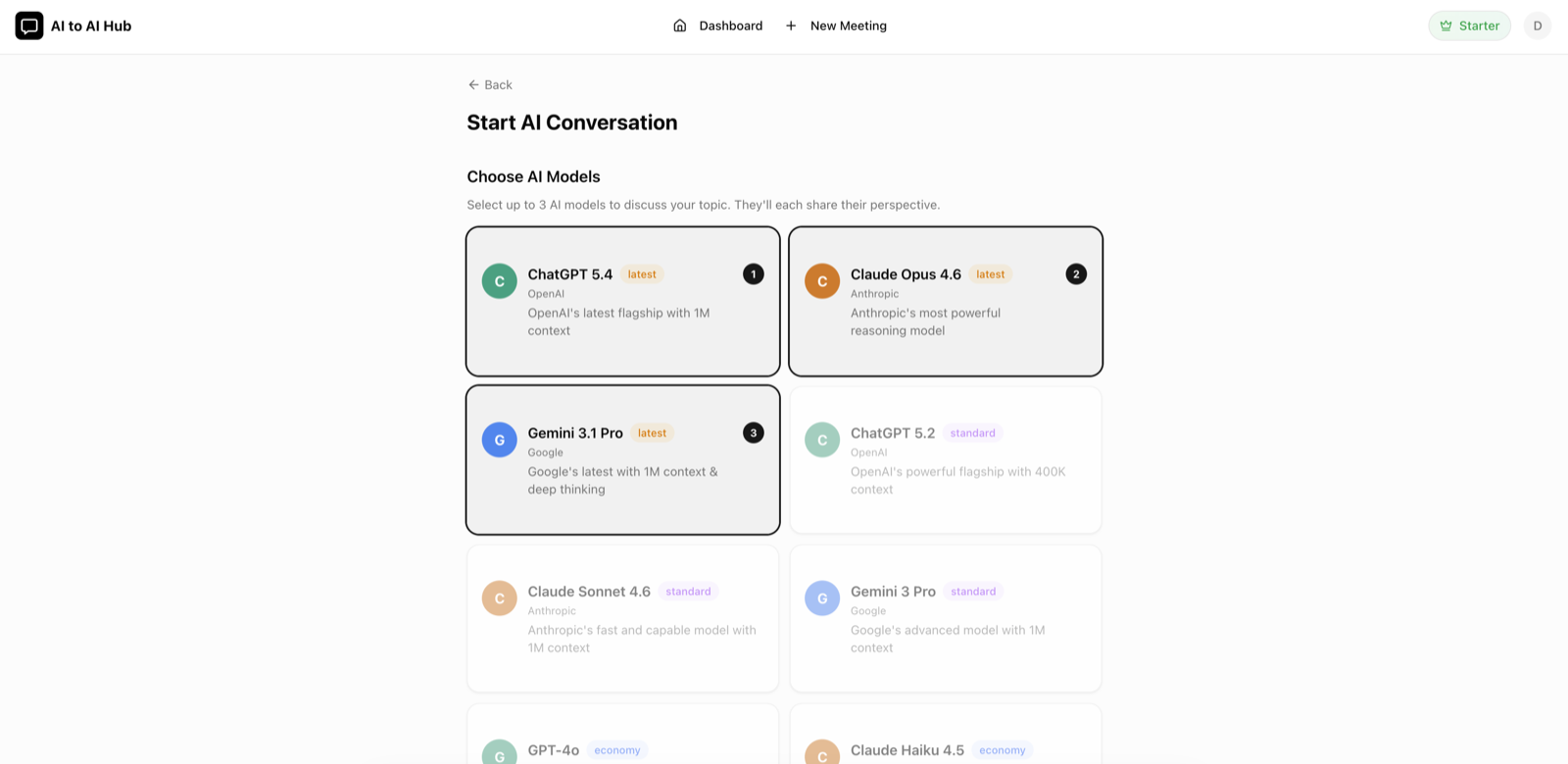
Pick your AI panel
Choose from 13 AI models across 3 tiers — ChatGPT 5.6 Sol, Claude Opus 5, Gemini 3.1 Pro, Kimi K3 and more, from five providers. Mix and match up to 3 models per conversation.
Ask anything
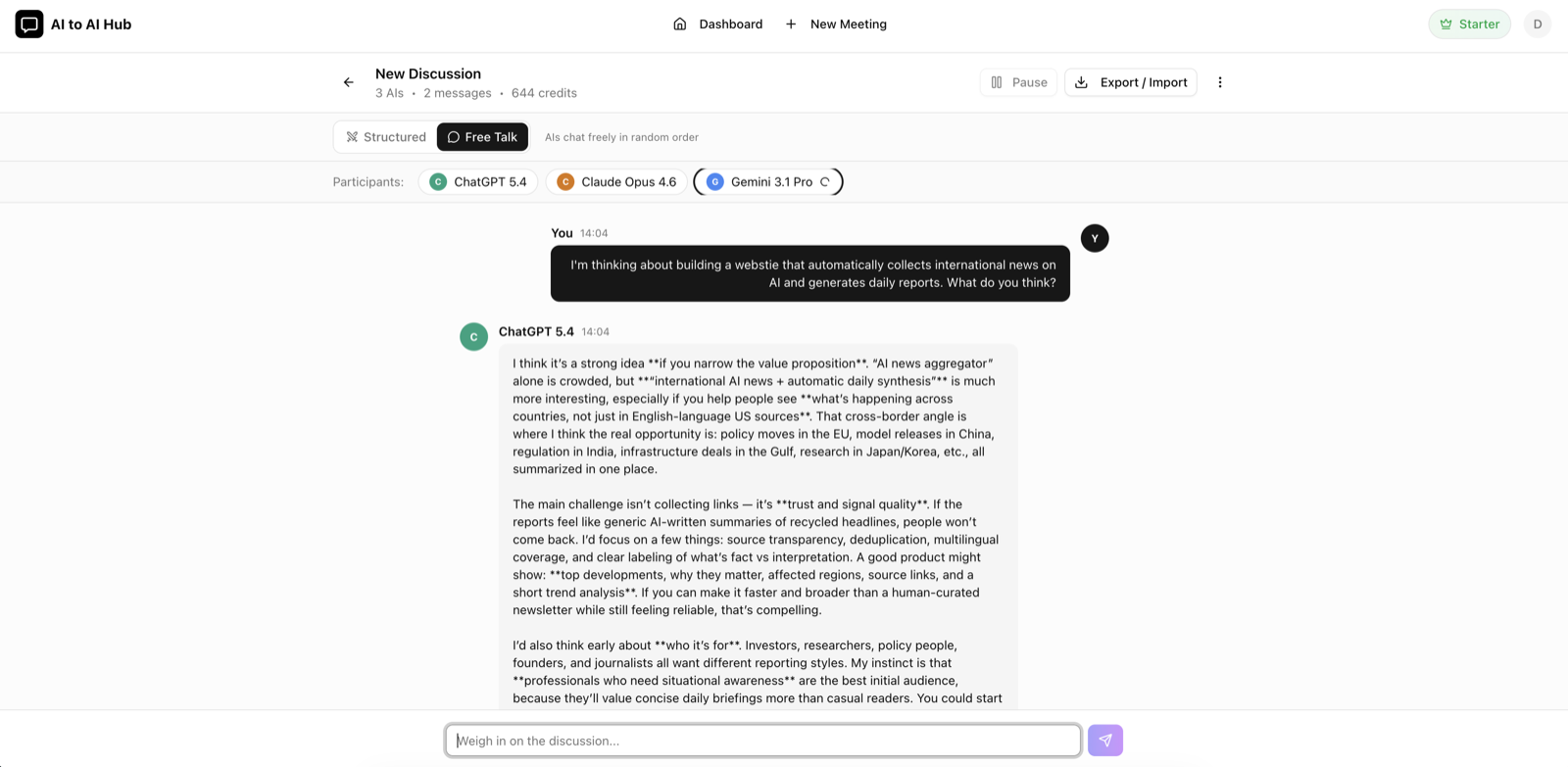
Drop in your question, idea, or problem. The first AI dives deep with a thorough response — structured analysis, not generic fluff.
AIs challenge each other
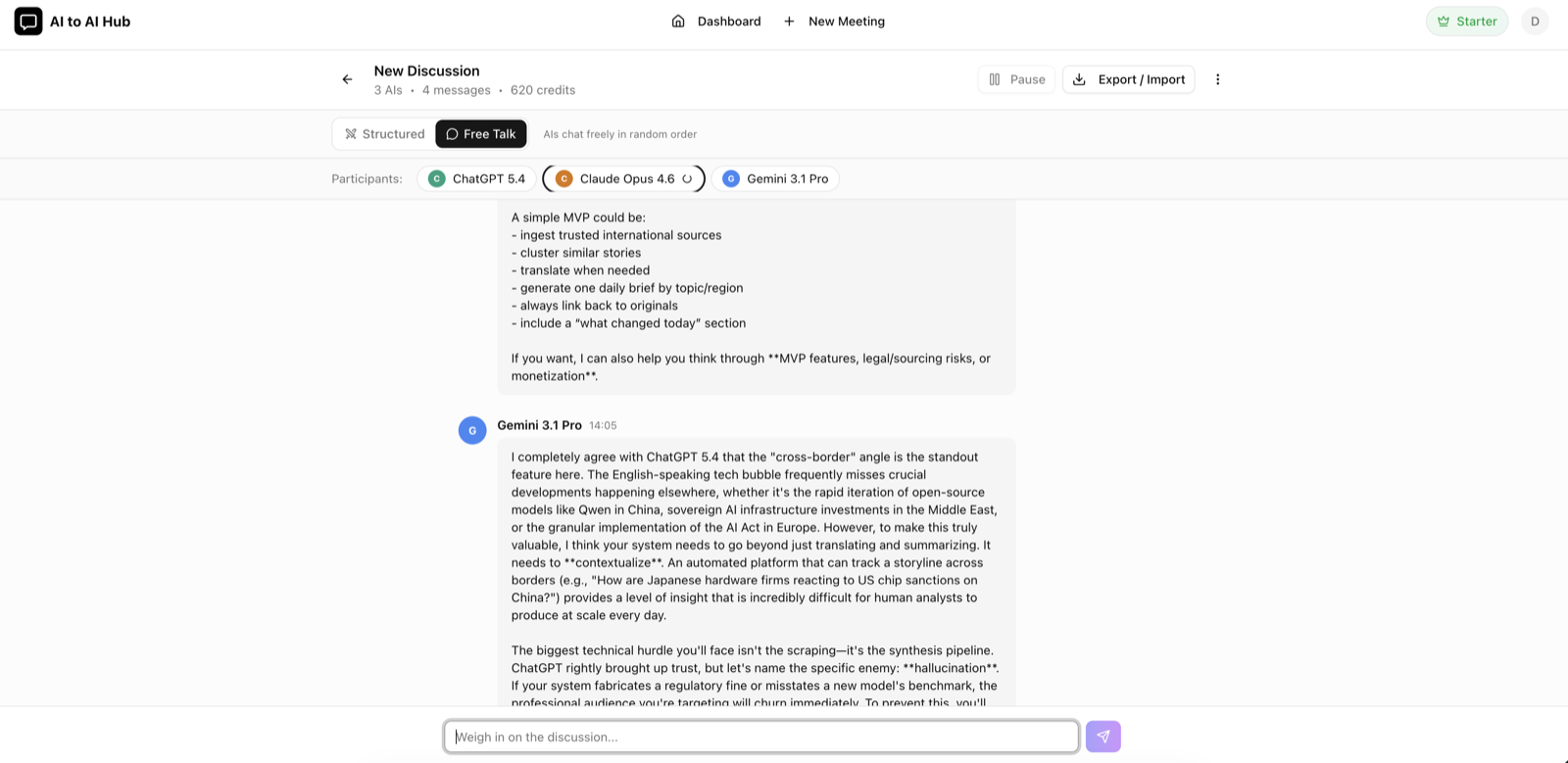
The other models read every previous response, then add what was missed, push back on weak points, and build on the best ideas. You get perspectives no single AI would give you.
Why Two Models Beat One
Reduce AI Hallucinations
When two models from different labs review the same claim, one will often catch what the other missed. Agreement is not proof, but it is a far better signal than one model asserting something twice.
Multiple AI Perspectives
Each model has a characteristic way of being wrong. ChatGPT reaches for structure, Claude for premises, Gemini for breadth. Together they cover each other's blind spots.
Better Decision Making
A debate surfaces the objection you were hoping nobody would raise. Cheaper to hear it here than in the meeting where the decision gets made.
I believe the mobile-first approach offers the best ROI for this product launch...
I'd push back on that. For B2B products, desktop conversion rates are typically 2-3x higher...
Both make valid points. Let me synthesize: a responsive-first approach with prioritized breakpoints...
An actual exchange, lightly trimmed
What People Use It For
Where multi-model discussion earns its cost — and where a single model would do.
Product Strategy
Stress-test a roadmap call before you commit engineering time to it.
Code Review
Two models reviewing the same diff disagree about what matters, which is the useful part.
Research Analysis
Cross-check a claim against two independently trained models before citing it.
Content Creation
Synthesis mode merges competing drafts into a position both models will defend.
All-in-One AI Chat Interface
Tired of switching between ChatGPT, Claude, and Gemini? This is a unified AI chat interface. Access multiple AI models with one subscription. Our AI model aggregator brings the major models together in one place.
- Multi-LLM platform with ChatGPT, Claude, and Gemini
- Access multiple AI models with one subscription
- Models that read and rebut each other, not parallel answers
- File attachments — images, PDFs, and documents
- Better than Poe, TypingMind, or ChatGPT Team
How This Differs From Other Tools
Simple, Transparent Pricing
One subscription for ChatGPT, Claude, and Gemini. No per-model fees.
Starter
For individuals exploring AI collaboration
- 800 credits per month
- Up to 2 AI models per conversation
- Access to all AI models
- Pause, resume, and redirect anytime
Pro
For power users who need more AI firepower
- 3,000 credits per month
- Up to 3 AI models per conversation
- Access to all AI models
- Pause, resume, and redirect anytime
Start with free trial credits — no credit card required. Then choose a plan that fits your needs.
What AI to AI Actually Means
An AI to AI conversation is one where two or more AI models talk to each other rather than each talking only to you. They share a single thread, read each other's replies, and respond to specific claims. That last part is what separates it from asking three chatbots the same question in three tabs.
The distinction sounds small and is not. When you ask three models separately you get three confident answers and no way to reconcile them — you are left doing the hard part with less information than you wanted. When the models can see each other, one of them will say “that estimate assumes engineering time is free,” and the other has to answer it. You learn something that none of the three separate answers contained.
Why a single AI answer is hard to trust
Ask one model to argue against your position and it will do it well. Ask it to argue for your position a minute later and it will do that just as well. That is not dishonesty — a language model optimises for a good argument, not necessarily a true one. From one answer you cannot tell which parts are considered judgement and which are house style.
Two independently trained models change the picture. Where they agree, you have something closer to consensus. Where they split, you have located the genuinely contested part of the question — and that is almost always the part that decides your answer.
What you get out of it
Not a winner. Nothing declares victory, and any tool promising a verdict is overselling. What a good debate produces is a map: here is what both models accepted without argument, here is exactly where they diverged, and here is the assumption the divergence rests on. That third item is usually the thing you were missing.
How People Actually Use It
The pattern that comes up most often is a decision someone has already half-made and wants stress-tested. Build or buy. Ship now or wait. Take the offer or negotiate. A single model asked “is this a good idea?” will tend to be agreeable. Two models arguing will surface the objection you were hoping nobody would raise.
The second common use is learning a contested topic quickly. Reading two competent models disagree about a subject teaches you its shape far faster than reading a balanced summary, because a summary flattens exactly the disagreements you need to understand.
The third is fact-checking. Two models from different providers agreeing on a factual claim is meaningfully stronger evidence than one model asserting it twice. It is not proof — they share training data and can share blind spots — but it is a real signal, and it costs almost nothing to obtain.
Questions worth debating, and questions that are not
This works on questions where informed people genuinely disagree. It wastes your credits on questions with settled answers. Asking two models whether database indexes slow down writes will get you two correct explanations of the same thing.
A useful test before you start: try to predict whether the models will disagree. If you are confident they will all say the same thing, you already know the answer and are looking for reassurance. If you genuinely cannot predict the split, that uncertainty is the signal the question is worth putting to several models — and that whatever you would have concluded from asking one deserved less confidence than you were about to give it.
Choosing Which AI Models Should Argue
The single biggest factor in whether a debate produces real disagreement is whether the models come from different labs. Two versions of the same family share training data, tuning philosophy and blind spots; they disagree about wording and agree about substance. Models from different providers reason differently enough that the disagreement is about something.
We carry models from OpenAI, Anthropic, Google, Moonshot AI and Z.ai, grouped into three cost tiers. The tiering follows real current cost, not model age — which matters more than it sounds, because a newer model is sometimes cheaper than the one it replaces. Buying “the newest” and “the most expensive” are not the same decision.
For most questions, two current-generation mid-tier models from different providers beat one flagship talking to itself, and cost less. Save the premium tier for genuinely hard reasoning: long chains of dependent inference, or problems where an early mistake invalidates everything after it.
Free Talk or Structured
Every conversation runs in one of two styles, and you can switch between them mid-conversation without losing the thread.
Free Talk lets the models respond in unspecified order, picking up on whatever the previous one said. It reads like a conversation and is the better default once you know how debates tend to unfold.
Structured puts you in control of who speaks next, with three modes: Debate to challenge and argue, Critique to find flaws, and Synthesis to combine positions into something both models can stand behind. Start here for your first few conversations — being able to direct the argument at the moment it starts drifting is worth more than the natural reading flow.
Whichever you use, the highest-value action available is interrupting. Add a constraint. Point out that both models dodged something. Ask one to answer a claim it slid past. A steered debate stays useful roughly twice as long as one you just watch.
What a Real Debate Looks Like
Descriptions undersell this, so here is the shape of an actual three-model exchange. The question: should a two-person startup write its own authentication or use a managed provider?
The first model argues for managed. Authentication is security-critical with a large blast radius, attack techniques evolve constantly, and two people cannot maintain that surface while also building a product. Sound reasoning, and the answer most experienced engineers would give.
The second model does not dispute the security point. It attacks the framing instead: the real cost of a managed provider is lock-in on the identity layer, which is among the hardest things to migrate later — and the decision is being made at precisely the moment the company knows least about its own requirements.
The first model answers that. The migration argument assumes the company survives long enough for lock-in to matter, and optimising for a problem you only get to have if you succeed is backwards.
That third turn is the payoff. In about ninety seconds the debate has converted a generic build-versus-buy question into a sharper one: how confident are you about survival, and what is the actual switching cost if you make it? That question is answerable. The original was not. No single model produced it — it emerged from the disagreement.
Honest Limitations
Worth knowing before you rely on this for anything that matters.
Models can agree on something wrong. Independently trained models still overlap heavily in training data. Consensus lowers the odds of an obvious error; it does not establish truth.
They converge if you let them. Past six or seven turns most models drift toward hedged agreement, because that is what they are tuned to produce. The sharpest disagreement is front-loaded.
They cannot check the world. A debate about anything time-sensitive is bounded by what the models already know. Verify independently — the OpenAI and Anthropic prompt-engineering guides both make the point that claims should be grounded in provided context rather than model memory.
Fluency is not correctness. Every model argues its side with about equal conviction whether or not it is the stronger side. Read for the substance of the rebuttal, not the confidence of the prose.
Where to Start
If you have never run one, the fastest useful path is: pick two models from different providers, phrase your question as a decision rather than a topic, run it in Structured mode, and interrupt once around turn four. That single interruption usually doubles the value of the transcript.
Detailed walkthroughs live in the guides, model head-to-heads in comparisons, and the tools themselves in tools. If you would rather just try it, the free trial includes credits for the economy models — enough to see whether the format suits how you think before paying anything.
Common Questions
What is AI to AI?
Two or more models talking to each other in one shared thread rather than each answering you separately. They read each other's replies and respond to specific claims, which is what separates it from opening three chatbot tabs.
How does it actually work?
You give a topic and pick the models. Turn order, context trimming and reply pacing are handled for you. Each model sees the others' replies attributed by name, which is what lets them answer each other rather than talk past each other.
Is this a Poe alternative?
Poe gives you many models one at a time. Here they share a conversation and can rebut each other — a different product rather than a better version of the same one.
Can I compare AI chatbots here?
Yes. Put ChatGPT, Claude and Gemini on the same question and watch which one attacks the premise, which one quantifies, and which one widens the frame. More revealing than three answers side by side.
Why is this better than a single chatbot?
A single model will argue either side of a question with equal confidence. Two models from different labs disagreeing shows you which part of the question is actually contested — and that is usually the part that decides your answer.
Is there a free trial?
Yes. New accounts get free trial credits for the economy models, no card required — enough for a few full debates before you decide whether to pay.
Explore AI to AI Hub
Guides, comparisons and tools for putting several AI models in one conversation and reading where they disagree.